
Battery Storage by State: Where the Best Opportunities Are
A state-by-state look at where battery storage opportunity is emerging — mandates, installed capacity, and how much runway developers have left in each market.
Eighty percent of the battery storage capacity developers plan to add in 2026 is concentrated in three states, and the state with the best incentive stack isn’t one of them.
For BESS developers and EPCs, the decision happens at the regional level through ISO/RTO market rules, interconnection queues, and state procurement mandates—whether for behind-the-meter (BTM) commercial systems or front-of-meter (FTM) utility-scale assets.
The EIA is calling for 86 GW of new utility-scale capacity in 2026, a record year with solar, storage, and wind representing 93% of that total. Zoom in on storage specifically and the growth is just as striking:
Developers plan to add 24 GW of utility-scale battery storage in 2026, up from a record 15 GW added in 2025 — enough to take total installed capacity from roughly 44.6 GW to more than 67.5 GW by the first quarter of 2027 (EIA data via pv magazine).
Here’s how that pipeline breaks down by these three states:
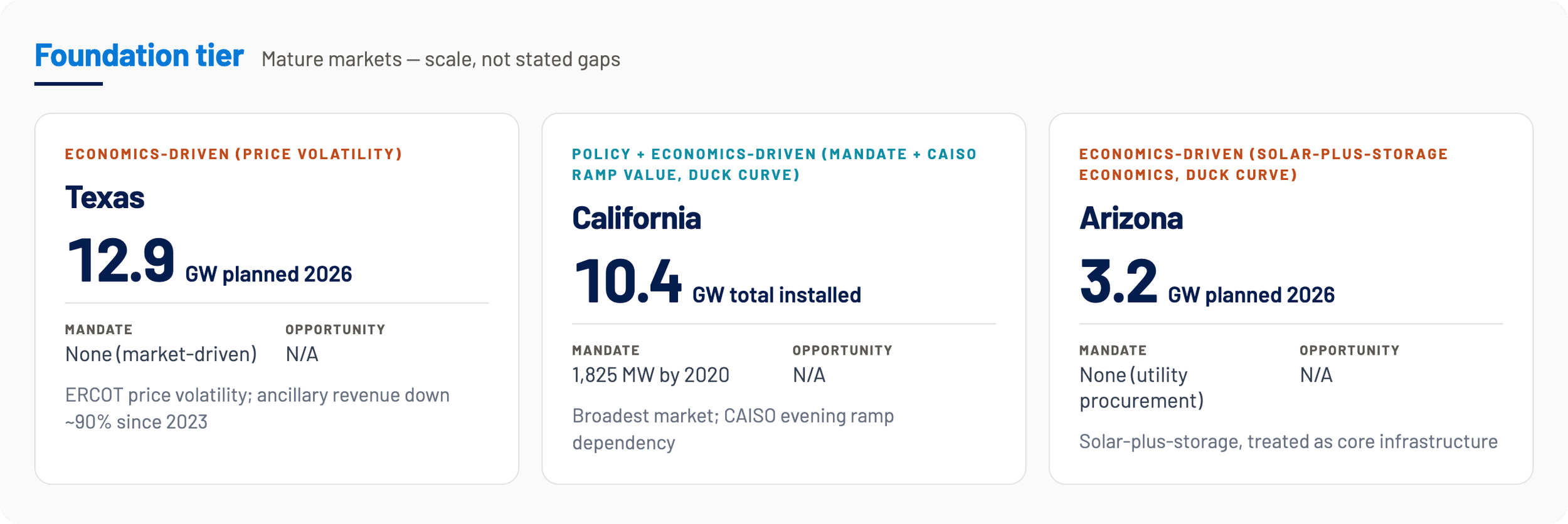
53%
Texas
14%
California
13%
Arizona
That’s the real takeaway for procurement teams: a market-driven state like Texas rewards speed and flexible sourcing, while an incentive-stacked state like New York or Massachusetts rewards knowing how to layer program eligibility, interconnection timing, and financing structure. Treating every state as the same sourcing problem is how projects lose months to a mismatch between system design and the program that was supposed to pay for it.
Where the GW volume currently sits
Texas remains the best example of a market-driven state — and notably, has no statewide storage mandate or incentive program. ERCOT's structure rewards flexible assets directly; price volatility and scarcity pricing make batteries a straightforward economic bet, with less dependence on incentive programs than almost anywhere else.
California is still the broadest market across every BTM/FTM segment, driven by high retail rates, non-wires alternatives at the distribution level, and a CAISO grid that increasingly depends on storage to manage the evening demand ramp as solar drops off.
Arizona has become one of the clearest solar-plus-storage states in the country, with utility procurement that now treats storage as core infrastructure rather than a supplemental technology.
Beyond those three foundational states, a second wave of markets is building real momentum. New York, Massachusetts, and Illinois in particular are shifting from policy on paper to markets developers actually need a strategy for — which is where the state-by-state breakdown below gets interesting.
Emerging opportunities: States to watch
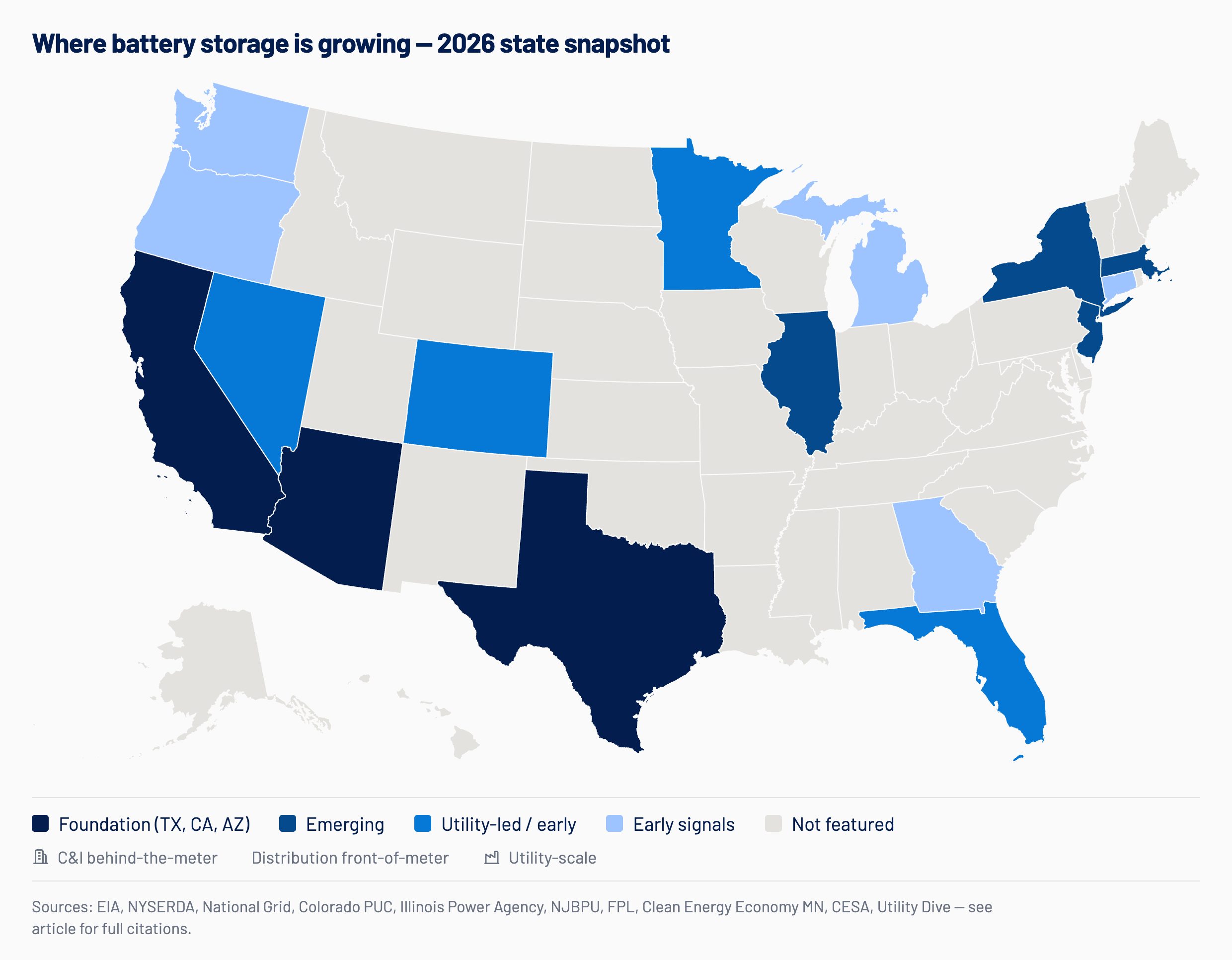
What's driving that growth varies from state to state. Some states move on programmatic support: a legal mandate, a procurement target, an incentive program. But others need no policy at all; high retail rates, steep demand charges, a solar-heavy grid with a real duck-curve problem, natural disaster resiliency, or simply high load growth can make storage pencil on its own.
A handful of states have all the above needs, but knowing which primary driver influences a state affects how a developer may weigh their next target region.
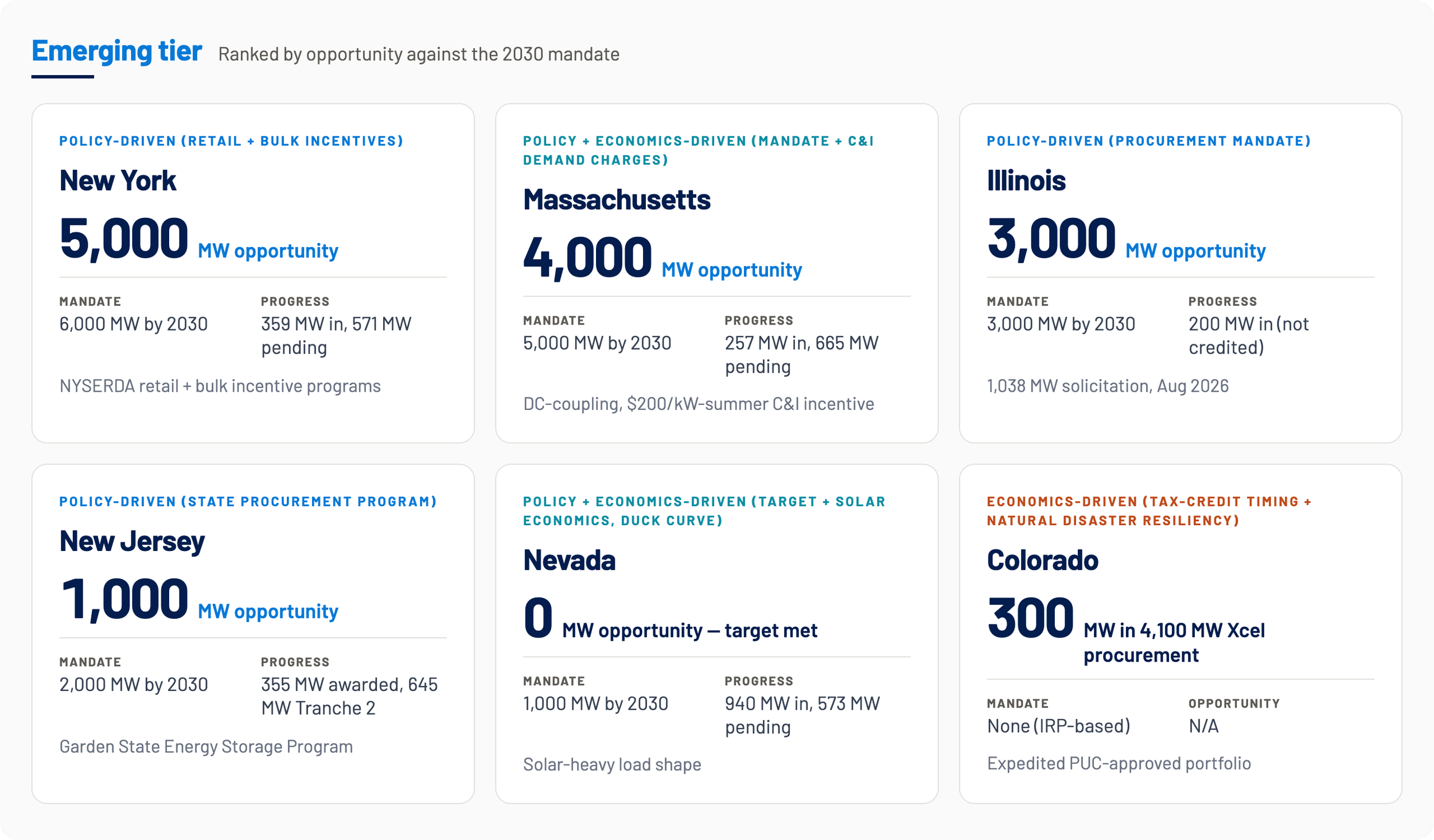
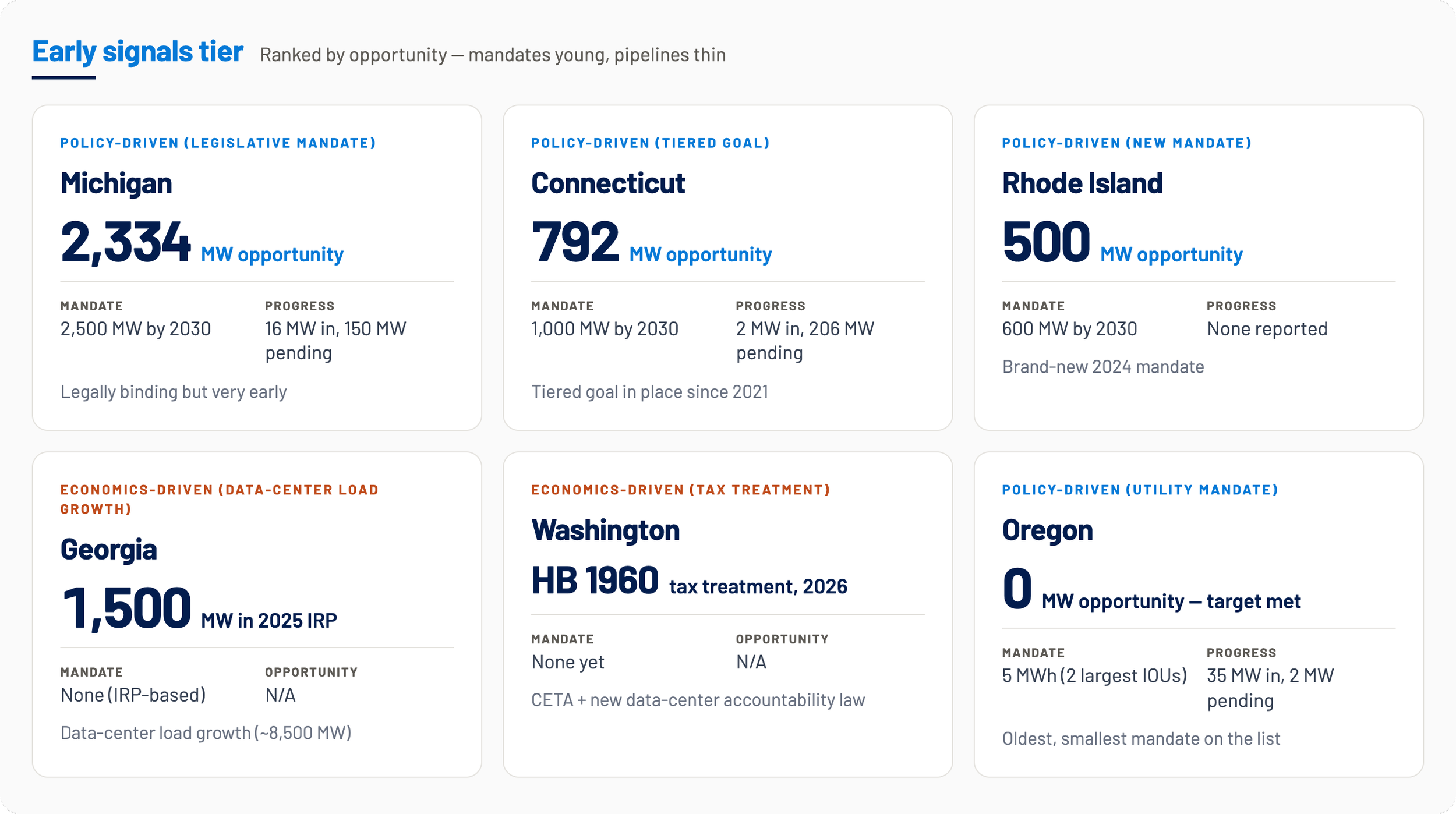
Mandate & target sources: Clean Energy State Alliance
New York is one of the most important developer markets outside the Southwest for distribution-connected and C&I storage. NYSERDA's Retail Energy Storage Incentive Program supports new commercial-scale distributed storage projects up to 5 MW, with $675 million authorized toward a 1,500 MW commercial-scale target by 2030. On the utility-scale side, NYSERDA's Bulk Energy Storage Program is running annual Index Storage Credit solicitations toward a 3,000 MW goal (NYSERDA).
Massachusetts stands out specifically for C&I: it's currently the only state accelerating DC-coupled systems that allow excess PV generation when paired with storage, which makes projects more complex to procure. But ultimately these more complex projects can support higher margins for equipped teams. On the incentive side, National Grid's own ConnectedSolutions program materials for C&I customers show a $200/kW-summer incentive for qualifying BTM battery systems, locked in for five years (National Grid).
New Jersey is moving from a watch-list state to a real pipeline. The Garden State Energy Storage Program covers both grid-supply (utility-scale) and distributed storage; the state awarded 355 MW in its first tranche and has since closed bidding on a second, larger tranche of roughly 645 MW (Utility Dive).
Nevada benefits from heavy solar penetration and rising value for shifting midday generation into the evening peak, with strong utility-scale and distribution-level FTM fundamentals — the same duck-curve dynamic driving growth in Arizona and California (Utility Dive).
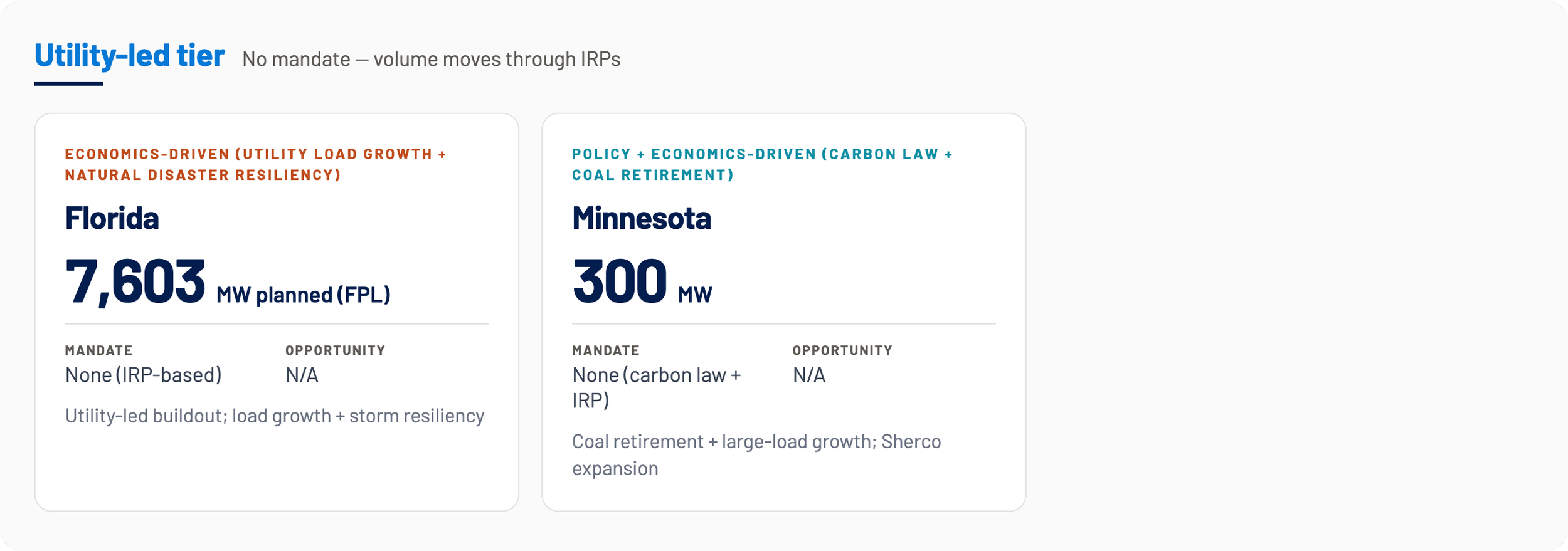
Colorado just took a meaningful step: the Colorado Public Utilities Commission approved up to 4,100 MW of new generation for Xcel Energy in an expedited procurement, including 300 MW of battery storage, aimed at getting projects moving before federal tax credit changes take effect. Wildfire risk is adding a second layer of urgency, pushing utilities toward storage as part of broader grid-resiliency planning (Colorado Sun;Colorado PUC).
Illinois is turning policy into procurement. The Illinois Power Agency plans an initial solicitation on or before August 26, 2026, for 1,038 MW of standalone, 4-hour storage across MISO and PJM territory, structured around 20-year Indexed Storage Credit contracts — a concrete program with a real timeline and contract structure, not just a target (Illinois Power Agency).
Florida is a real storage state, but a utility-led one. Florida Power & Light's 2025–2034 plan includes 7,603 MW of battery storage, meaning the opportunity here potentially looks more like utility partnership than open developer market. Further, hurricane resiliency is as much a driver here as raw capacity growth (FPL's 2026–2035 Ten Year Site Plan).
Minnesota is worth watching as well. Xcel Energy is retiring its 2+ GW Sherco coal plant in stages through 2030 as part of Minnesota's 100% carbon-free electricity law, and replacing that capacity with solar and storage at the same site. In October 2025, Xcel asked Minnesota regulators for approval to double the battery capacity originally planned for Sherco and add a fourth, 200 MW phase (Clean Energy Economy MN, 2026 Energy Factsheet). At the regional level, MISO has flagged a potential capacity shortfall in its Central and Northern regions as coal retires faster than replacement capacity comes online (Utility Dive).
Early signals
A handful of additional states are worth keeping on the radar. Michigan has a legally binding 2,500 MW mandate by 2030, though installed capacity is still in the low double digits. Connecticut and Rhode Island have both set tiered, multi-year procurement goals — but neither has meaningful installed capacity yet.
Georgia has no formal storage mandate, but Georgia Power's 2025 Integrated Resource Plan calls for 1,500 MW of battery storage tied to roughly 8,500 MW of anticipated data-center load growth over the next six years (Utility Dive). Washington doesn't have a storage target either, but a law taking effect this year creates favorable tax treatment for battery storage, alongside a separate bill bringing data centers under the same clean-energy accountability rules as the rest of the grid (Washington State Legislature).
GridVest's take: the states with the best programs aren't always the states with the most straightforward economics, and vice versa. Texas wins on market structure alone. New York and Massachusetts require knowing how to work incentive stacking and distribution constraints. Illinois and New Jersey are becoming serious markets because the state is building a path. Storage is no longer one national market; it's a portfolio of state markets with different revenue logic, and the winners will be the teams that treat C&I and utility-scale storage as genuinely different businesses rather than one product with a map overlay.
Key policy signals to watch
FERC Order 1920 requires transmission providers to plan on a 20-year horizon. Compliance filings indicate MISO, PJM, ERCOT, and New York/New England markets have significant regional transmission needs—reasonable signals for where distribution-level storage demand follows.
Recent developments:
Illinois approved Commonwealth Edison’s virtual power plant (VPP) program for 2027 launch
New Jersey closed bidding on its second storage tranche
State and regional decisions matter more than federal policy in determining BESS growth over the next several years, which means the sourcing and financing playbook that works in ERCOT won’t be the one that works in NYISO. The developers and EPCs who build state-specific strategies, rather than one national approach, will be the ones capturing this pipeline instead of chasing it.
It’s worth sitting with how concentrated that build-out still is: again, roughly 80% of a record 24 GW pipeline is landing in three states, while more than a dozen others sit in the Utility-Led, Emerging and Early Signal tiers above — with mandates and IRPs in place, procurement still catching up.
If storage adoption in those states closes even part of the gap with Texas, California, and Arizona, 2026’s record won’t be the ceiling for this market, it’ll be the floor.
