
Battery Storage for Data Centers: What Options Are Playing Out
Battery storage and BESS terminology are widely used in discussions around data center development, but the meaning and application of the term has become vague with time.
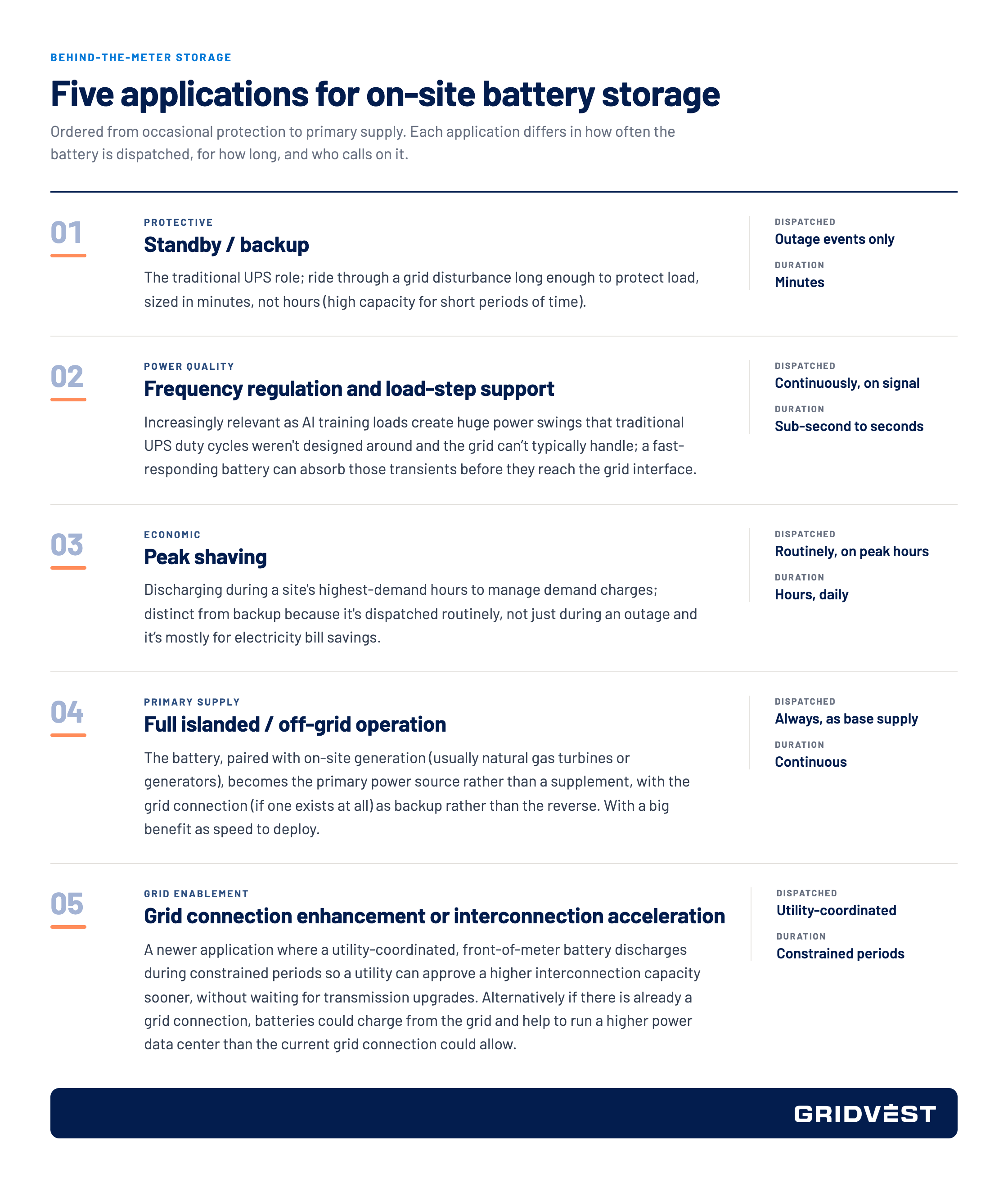
A battery energy storage system installed at a data center might be handling backup power, frequency regulation, electricity spikes, peak shaving, operating in full islanded operation, or expanding an existing grid connection. Two projects can both be described as "adding BESS" and have almost nothing in common: different sides of the meter, different job the battery is doing, different sizing logic, different reasons the finance team signed off on it, etc. Or sometimes it’s doing a little bit of everything.
This piece breaks down what BESS is actually doing inside a data center's power architecture, how that changes with scale and use case, and which technical approaches are gaining traction.
Data center power demand isn't a niche planning problem anymore
EPRI estimates data centers account for roughly 4–5% of total U.S. electricity demand today, a share it projects could climb to somewhere between 9% and 17% by 2030.
[CALL OUT BOX]
According to the Q3 2026 Energy Storage Market Outlook from SEIA, U.S. commercial and industrial (C&I) battery installations were up sharply, and data centers accounted for roughly three-quarters of all C&I storage capacity installed (not including utility-scale projects, which also added capacity).
The same report projects data center demand for batteries will grow roughly 5x by the end of the decade. Interconnection queues in constrained markets can take years but it's one variable, not the whole story, and it shouldn't be the only lens a developer uses to pick an architecture.
What "BESS for a data center" actually covers
Strip away the jargon and a battery system at a data center is usually doing one or more of the following:
Scale changes the answer
Hyperscalers gets most of the headlines, but it's worth sizing the rest of the data center market.
Synergy Research Group put hyperscale operators at 48% of global data center capacity by the end of 2025 — a share it projects will grow to 67% by 2031. The remainder splits between non-hyperscale colocation (~20%) and enterprise on-premises facilities (~32%).
> Hyperscale campuses (100 MW+) typically deploy multiple large BESS blocks, often integrated with on-site generation, and can justify pairing several of the use cases above in a single system: backup, load-step management, and interconnection acceleration. The economics can support this complexity, as system sizes and capital available make multi-purpose architectures worth the added engineering.
> Smaller-footprint sites (5–20 MW) can introduce a different sizing problem entirely. These projects typically need one or two containerized systems, usually deployed behind the meter (BTM), sized primarily around backup and peak shaving rather than grid-services participation. The underlying battery technology is often similar to what's deployed at hyperscale (same chemistry, comparable inverter platforms), but the financing structure, procurement timeline, and urgency drivers are often not the same.
Use case shapes the spec
A training cluster's power draw can swing by tens of megawatts within milliseconds as GPU utilization ramps up and down in sync across a facility. An inference-serving cluster's load profile looks considerably closer to a conventional data hall, with smoother, more predictable draw. That difference shows up directly in system specification: C-rate requirements, inverter response time, and battery cycling patterns — and by extension, warranty terms — differ meaningfully between the two.
[CALL OUT BOX]
A system sized and warrantied for inference-style duty can be poorly matched to a training-style load profile, and vice versa. This is a conversation that needs to happen at the OEM selection stage, not after commissioning.
Four architectures to consider
Pulling the above together, most current data center BESS deployments fall into one of four architectural patterns:
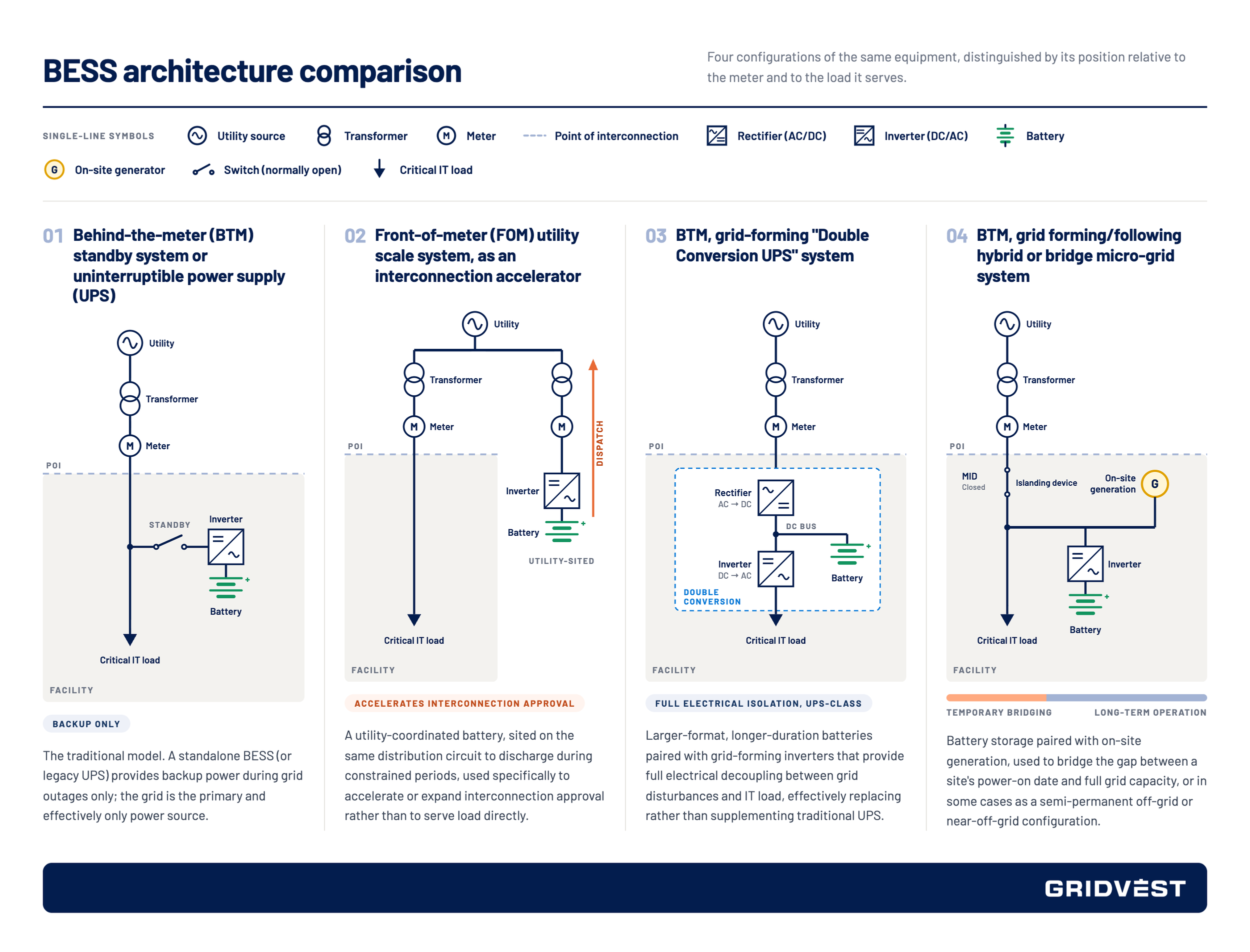
None of these four is universally "correct," and the honest answer to which wins out over the next several years is that it depends on scale, workload, and site-specific grid conditions.
That said, one pattern is worth naming directly: research modeling flexible interconnection approaches found that combining flexible grid connections with a "bring-your-own-capacity" structure allowed a modeled 500 MW data center to reach full operation in roughly two years, three to five years faster than a traditional interconnection process, while reducing the new generation capacity the grid needed to build to serve that load.
Findings like this, combined with regulatory movement at FERC toward accommodating flexible, storage-backed loads, suggest hybrid and accelerator-style architectures are positioned to keep gaining ground. That's a reasonable directional bet, and plenty of sites will continue to be well served by straightforward standby architecture or a BTM grid-forming system.
Where the complexity actually lives
Interconnection queues and grid-equipment shortages are a front-of-meter-heavier problem. Utility-scale storage is facing its own multi-year queue and equipment shortages, especially for transformers and specialized circuit breakers in particular. A BTM system generally isn't subject to that same queue, which means these smaller architectures can sometimes move faster by sidestepping the queue.
Vendor-origin and equipment compliance risk applies across the board, and it now comes in two distinct layers. The first is import and installation risk, with an executive order signed August 2026 declaring a national emergency over the security of the U.S. bulk-power system. This gave the Department of Energy authority to block the acquisition, importation, transfer, or installation of utility-scale grid equipment from China — including battery storage systems, inverters, and industrial control systems — if a transaction is linked to a Prohibited Foreign Entity. The second, separate hurdle is Foreign Entity of Concern (FEOC) compliance tied to Investment Tax Credit eligibility — a different test against different ownership criteria, but one that applies to the same equipment.
What this means for BESS procurement
Whatever architecture fits a given site, a few questions are worth putting in front of any equipment partner or procurement team before locking in a design:
What is this system's primary job — backup, peak shaving, interconnection acceleration, or some combination — and does the spec actually match that job?
Does the sizing logic reflect the site's actual scale and workload, or a template borrowed from a very differently sized project?
What's the country-of-origin exposure across the battery, inverter, and controls stack under the new executive order, and does the same equipment separately clear FEOC for tax credit eligibility, if needed? Or can you develop the project without the tax credit and save a lot of time and upfront cost?
Does the financing structure survive a project timeline that may run two to three years from decision to commercial operation?
For larger scale projects, where system architecture, OEM selection, and phased financing intersect with real engineering complexity, that's the kind of evaluation GridVest's advisory work for data centers is built around. We provide vendor-agnostic BESS procurement and/or sourcing guidance for developers navigating exactly this set of tradeoffs.
Sources
EPRI, Powering Intelligence 2026: Updated Scenarios of U.S. Data Center Electricity Use and Power Strategies, Feb. 26, 2026 — https://powering-intelligence.epri.com
SEIA / Benchmark Mineral Intelligence, Energy Storage Market Outlook, Q3 2026
Yale Environment 360, "Data Centers are Helping Fuel a U.S. Battery Boom," Sept. 2, 2026
Camus Energy, Princeton University ZERO Lab, and encoord, Flexible Data Centers: A Faster, More Affordable Path to Power, December 2025
Avanza Energy (Christopher Johnson), "The Interconnection Fast Pass," Aug. 25, 2026
Avanza Energy (Christopher Johnson), "The 60-Day Clock: FERC Just Forced Six Grid Operators to Rewrite the Rules," Jul. 21, 2026
Distilled/Cleanview (Michael Thomas), "Why Amazon Is Building One of the Largest Solar Projects in America," Aug. 26, 2026
Executive Order 14420 (Aug. 26, 2026) — legal summaries via Crowell & Moring, McGuireWoods, Trade Compliance Resource Hub
GridVest internal webinar speaker brief, "The Data Center Power Question: How and Where Does BESS Fit In?"
Synergy Research Group, hyperscale vs. non-hyperscale global data center capacity share (2025 actuals, 2031 projection)
